
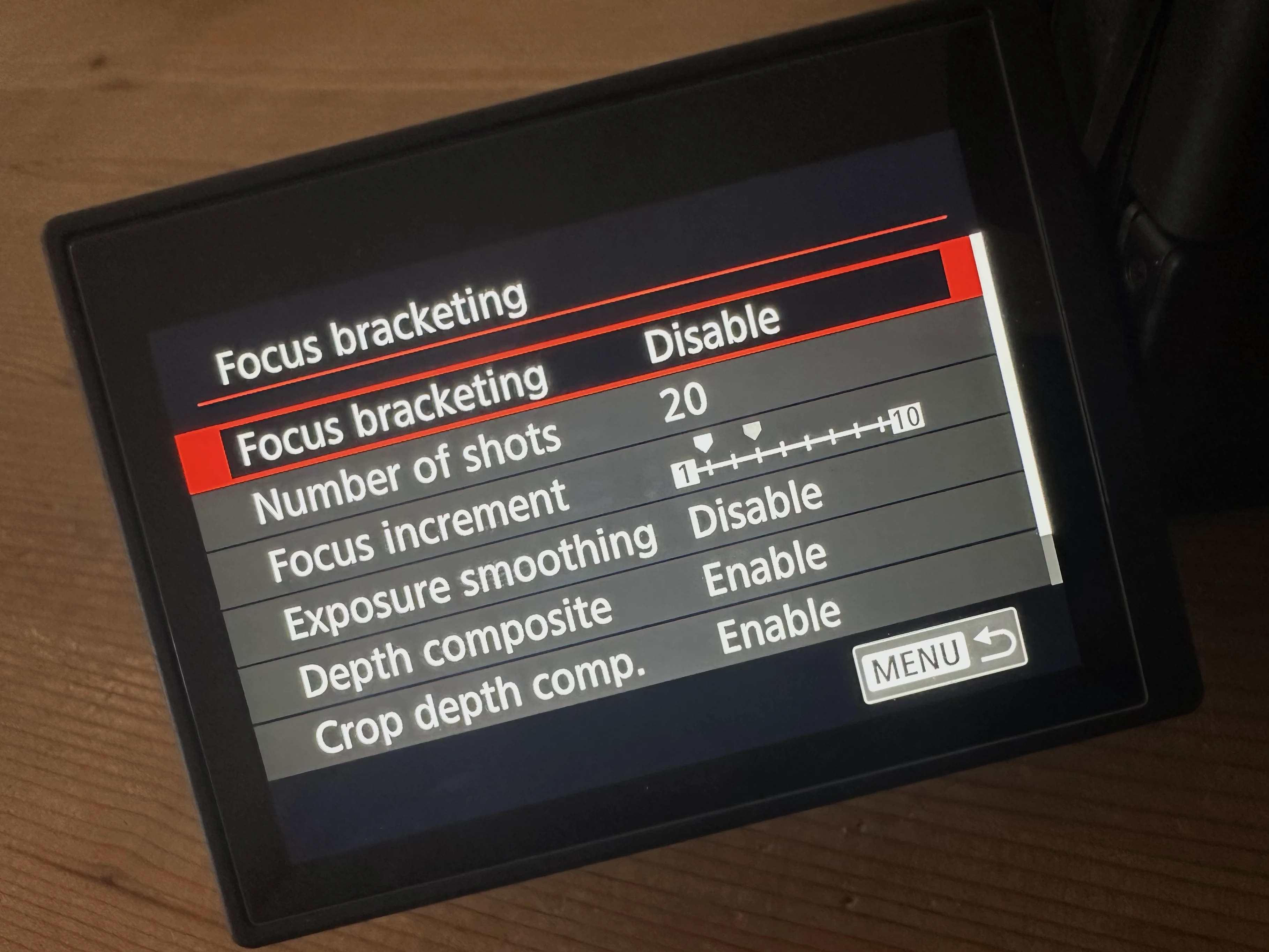
How automatic bracketing works
The principle is the same across every manufacturer: the camera shoots a series of photos, automatically shifting focus by a fixed step between each frame, until it covers the desired depth of field or reaches the number of shots you set. The settings follow the same logic from one brand to the next — number of shots, focus step, sometimes an interval between shots or an exposure correction — but the available ranges differ quite a bit, as the breakdown below shows.
- Canon (Focus Bracketing): adjustable number of shots, focus increment from 1 to 10 (default 4), and an exposure smoothing option that compensates for light loss tied to the changing focus distance — particularly useful in macro.
- Nikon (Focus Shift Shooting): up to 300 shots, focus step width from 1 to 10 (5 or below recommended to avoid gaps in sharpness), adjustable interval between shots, exposure lock on the first frame.
- Sony (Focus Bracket): 2 to 299 shots, focus step from 1 to 10. No in-camera stacking — the raw series has to be processed afterward.
- OM System: two distinct features not to be confused — Focus Bracketing (up to 999 shots, step 1 to 10, no stacking) and Focus Stacking (automatic merge, capped at 15 shots on the OM-1, 8 on the OM-5 — more on this below).
- Panasonic (Focus Bracket): focus step, number of shots, and the sequence direction (near → far or the reverse) are adjustable; no in-camera stacking.
- Fujifilm: 1 to 999 shots, focus step from 1 to 10, adjustable interval of up to 10 seconds between shots.
The incompatibility between flash and electronic shutter
Most in-camera focus bracketing systems use the electronic shutter to enable fast burst rates — Sony and Panasonic remain a notable exception, with a mechanical shutter. But the electronic shutter's line-by-line readout (rolling shutter) is generally incompatible with a regular flash at full speed — only a mechanical shutter, with a global sensor readout, natively allows fast sync with no cap.
As mentioned in the article on choosing a camera body for macro, only certain sensors — stacked sensors in particular — let you work around this limit. Here's the real picture, body by body.
Compatibility by brand and body
| Brand / body | Shutter | Flash compatible | Sync speed | Notes |
|---|---|---|---|---|
| Canon — non-stacked (R5, R6, R6 II, R6 III, R7, R8, R10, R50) | Electronic, forced | No | — | Hardware limitation tied to sensor readout speed; confirmed even in the R6 III's manual despite its recent release |
| Canon — stacked (R3, R5 Mark II, R1) | Electronic (fast readout) | Yes | 1/125s (FF) · 1/200s (1.6x crop) | The body waits for flash recycle confirmation before the next frame (confirmed with a Godox V480 on the R5 II) |
| Nikon Z8 / Z9 | Electronic | Not functional | — | The flash fires on the 1st frame then stays silent for the rest, regardless of the interval set (even at 30s). Likely a software bug/limitation, not fixed by firmware |
| OM System OM-1 / OM-1 Mark II | Electronic, silent, forced | Yes | 1/100s in bracketing (1/50s above ISO 16000) | Flash recycle delay adjustable in the menu; works natively with a fast flash (Godox, FL-700WR) |
| OM System OM-5 | Electronic, silent, forced | Yes | 1/50s | Same logic as the OM-1 |
| Panasonic (G9, G9 II, S5II...) | Mechanical | Disabled on the hot shoe by default | 1/250s (native TTL) · up to 1/500s (manual) | Workaround needed: DMW-FL580LE flash, certain Godox units (V1), or a manual PC sync cable |
| Sony (A7R V, A1, A7 IV, A7C II, FX3...) | Mechanical (most models) | Yes, natively | 1/250s (A7R V) · 1/400s mech./1/200s electronic (A1, A1 II) · 1/250s (A7R VI) | No in-camera stacking; Focus Bracket function absent on some older bodies (A7 III, A7R IV, A9 II) despite the latest firmware |
| Sony A9 III | Global shutter (no rolling shutter) | Yes (in bracketing, to confirm) | Up to 1/80,000s — no sync speed limit | Dedicated "Flash Timing Setting" to align third-party flashes with the global shutter; on paper the best option on the market for bracketing + flash, but no published field confirmation yet for the combined use case |
| Fujifilm (X-T5, GFX...) | Electronic | Yes, with caveats | ~1/125s (GFX100 II) | The Exposure Smoothing setting helps; occasional incompatibilities reported with some third-party flashes (Godox) |
The file the camera stacks for you
On some bodies (OM System in particular), the feature doesn't stop at raw bracketing: the camera can also assemble the images directly into a single stacked photo, ready to use. The catch: this composite file is usually saved as JPEG only — a format that leaves far less room to maneuver in post (exposure, white balance, noise reduction) than the series' individual RAW files.
This feature is still useful for a quick check in the field — confirming the series covers the whole subject before moving on — but for the final image, it's better to keep the series' RAW files and handle the stacking yourself in dedicated software (Helicon Focus, Zerene Stacker, Photoshop...), to keep full control over the result.
What to remember
- At Canon, the real criterion isn't the body's name but its sensor type: only stacked sensors (R3, R5 Mark II, R1) can sync a flash in electronic-shutter bracketing. The recent R6 Mark III is still excluded, for lack of a stacked sensor.
- Nikon Z8/Z9 is the market's weak point on this specific feature: the flash works fine in a regular burst but not in Focus Shift Shooting beyond the first frame — likely a software choice rather than a hardware problem.
- OM System is the most mature, reliable solution for macro use with flash, despite a more modest sync speed (1/100s) — not to be confused with the 1/250s listed in the general spec sheet, which refers to the mechanical shutter outside bracketing.
- Panasonic has the highest technical ceiling (mechanical shutter, up to 1/500s) but caps it on the hot shoe by default; a workaround (specific flash or sync cable) is needed to use it.
- Sony is the easiest brand to use with no workaround, with confirmed native operation, at the cost of stacking being handled in post rather than in-camera.
- The Sony a9 III, with its global shutter, removes any flash sync limit in theory — the best option on paper, though its combined use with bracketing still needs field confirmation.
In summary
Automatic bracketing with flash is still uneven ground from one brand to the next: Canon and OM System have solved it cleanly on their recent bodies (provided you have the right sensor), Sony works natively but without in-camera stacking, Panasonic needs a workaround, and Nikon still lags on this specific feature. These sync speeds and software behaviors shift with firmware updates — worth double-checking whenever you switch bodies.