
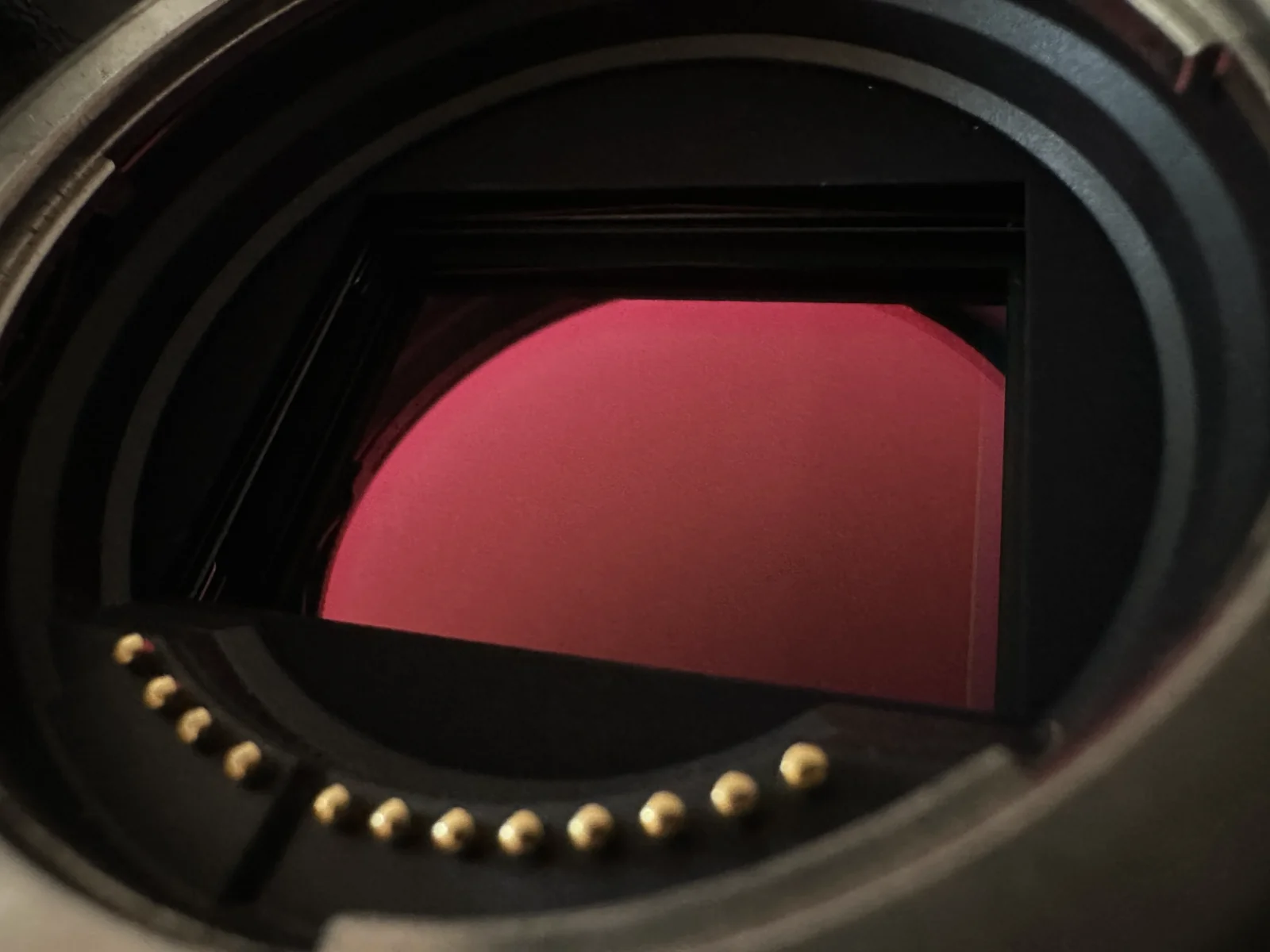
DSLR or mirrorless?
Choosing a camera body comes down to several parameters, largely tied to recent technological advances.
DSLRs keep one undeniable advantage: a huge secondhand market, with pro bodies available at prices well below an equivalent new mirrorless body.
But mirrorless cameras have taken a substantial technological lead. The electronic viewfinder, which lets you zoom directly into the image, offers focus precision far superior to an optical viewfinder. Autofocus is extremely responsive, and combining back-button focus (AF-ON) with a final manual adjustment gives a noticeably higher hit rate. In-body stabilization and low-light exposure preview (visible directly in the electronic viewfinder) are also real advantages.
Another interesting feature specific to recent mirrorless bodies: focus bracketing, which lets you shoot a semi-automatic focus stack. A valuable feature — but one that isn't usable with a flash on every sensor (see point 3).
Sensor format
There are four main sensor families: full frame, medium format, APS-C, and Micro Four Thirds.
Medium format, often very expensive, generally isn't aimed at macro, for lack of dedicated lenses.
For the other three formats, keep in mind that a lens's focal length is usually expressed relative to a full-frame sensor — and that the magnification obtained at a given focal length changes with sensor size:
- 100mm on full frame = 100mm
- 100mm on APS-C ≈ 150 to 160mm equivalent
- 100mm on Micro Four Thirds = 200mm equivalent
In other words, to get the same framing at the same focal length, you'd need to stand roughly 1.5 to 1.6 times farther away on APS-C than on full frame, and up to twice as far on Micro Four Thirds. And since one of the rules for good diffusion with a well-suited diffuser is precisely proximity to the subject, this is a parameter worth factoring into your choice of format.
We'll cover this proximity rule — along with the other key parameters for good diffusion (diffuser size, panel material) — in an upcoming article dedicated to using your diffuser.
Sensor type
On mirrorless bodies, one technology is gradually becoming the norm: the stacked sensor. Its main advantage for macro: it finally makes it possible to use flash together with the camera's focus bracketing function — a real asset for shooting efficient focus stacks in the field.
Unfortunately, not every body offers this, and the ones that do are generally more expensive. A few examples of stacked-sensor bodies compatible with flash + focus bracketing: the Canon EOS R5 Mark II, R3, and R1, or the OM System OM-1 / OM-1 Mark II, which specifically highlights focus stacking with flash and diffuser in its own documentation. The Sony a9 III goes even further with its global shutter sensor, which simply removes the flash sync speed limit altogether.
See the article Focus stacking — auto/assisted bracketing for the full breakdown of this compatibility, body by body.
In summary
Choosing a camera body for macro with a diffuser comes down to three axes: DSLR or mirrorless (secondhand market vs. focus precision and autofocus), sensor format (full frame, APS-C, or Micro Four Thirds — keeping in mind that a smaller sensor forces you farther from the subject at the same focal length, to the detriment of diffusion), and sensor type (stacked sensors, or even global shutter, which alone allow pairing flash with focus bracketing). A stacked-sensor body remains a pricier investment, but today it's the only route to efficient flash-lit focus stacking in the field.